Bibb County sits in the Fall Line Hills, the geological boundary where the Piedmont meets the Coastal Plain. Soils in this zone shift between red clay upland and sandy fill depending on which block you are on, a…
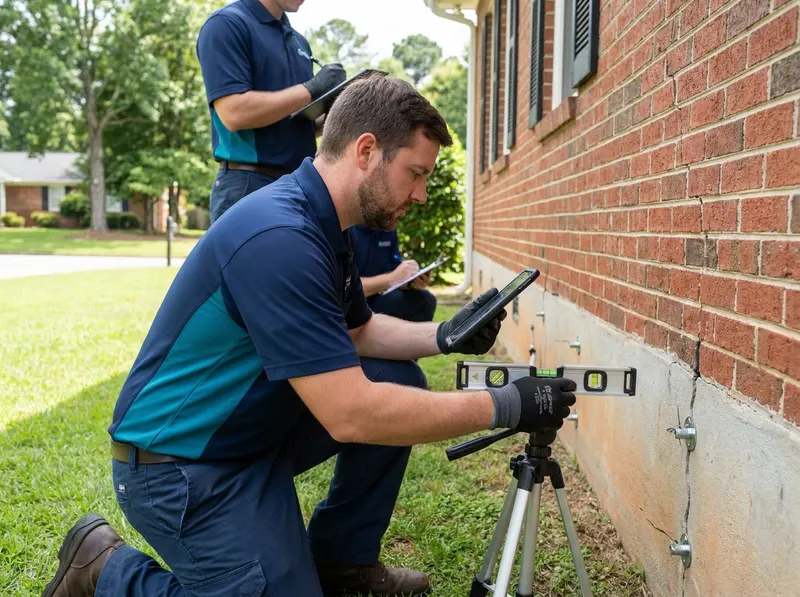
Bibb County sits in the Fall Line Hills, the geological boundary where the Piedmont meets the Coastal Plain. Soils in this zone shift between red clay upland and sandy fill depending on which block you are on, a dynamic that directly affects how foundations move and how long active settlement continues after it starts. In neighborhoods like Vineville and Ingleside, where many homes were built between the 1920s and 1950s on shallow continuous footings, a single stair-step crack in a brick veneer can represent decades of slow, stable creep or the early sign of accelerating movement. The only way to tell the difference is measured data collected over time.
Monitoring is the right fit when a homeowner notices a crack or sloping floor but an initial inspection cannot confirm whether movement is ongoing. It is also the appropriate step after a completed pier or wall repair, to verify that the installed system has arrested settlement and that adjacent unrepaired sections are not beginning to load-transfer. In areas like Shirley Hills and Wesleyan Woods, where mature hardwood root systems run beneath older slab-on-grade and pier-and-beam homes, seasonal soil moisture changes, especially during Macon's dry summers and wet winters, can cause cyclical movement that looks alarming but is not structurally progressive. Monitoring separates those two scenarios with numbers rather than guesswork.
A monitoring program at Postline Foundation Repair works in three numbered steps. First, a baseline visit establishes reference points: elevation benchmarks at each corner and mid-span, crack-width markers placed directly on masonry or drywall, and floor-slope readings taken with a digital level. Second, follow-up visits at agreed intervals re-measure every reference point and record the delta, the exact millimeters of change since the last visit. Third, a written findings summary is prepared after each visit and left with the homeowner regardless of outcome; if the data shows no measurable movement across three consecutive visits, the written summary says exactly that. Homeowners in College Hill and Napier Heights preparing for a refinance or sale have used those summaries as documentation for lenders and buyers, because the report reflects observed measurements rather than opinion.
The critical distinction homeowners sometimes miss: monitoring is not the same as repair, and it is not a substitute for repair when active movement is confirmed. If successive visits show measurable downward drift, even 2, 3 millimeters per month sustained over two or three intervals, that data becomes the evidence base for sizing a pier installation or wall stabilization correctly, rather than estimating from a single snapshot. Homes near the heavier clay soils of Huguenin Heights or the older fill zones around Bloomfield sometimes show exactly this pattern: apparent stability at first look, then slow confirmed movement in the data. Catching that early, with documented measurements, keeps repair scope smaller and cost lower than waiting until movement becomes visible to the naked eye.
Every job gets a firm, written price after a free on-site visit.
Tell us about your foundation settlement monitoring job in Macon and we'll send a clear, written quote, usually the same day.
 Postline Foundation Repair