Macon sits in the Piedmont region where the soil transitions between sandy loam and dense red clay within a single yard. That clay, common across Ingleside, Vineville, and Shirley Hills, absorbs rainfall slowly and…
Macon sits in the Piedmont region where the soil transitions between sandy loam and dense red clay within a single yard. That clay, common across Ingleside, Vineville, and Shirley Hills, absorbs rainfall slowly and holds hydrostatic pressure against basement walls for days after a storm. The Ocmulgee River basin amplifies this: neighborhoods like Unionville and Bloomfield near lower-lying terrain can see groundwater tables rise 18, 24 inches after a significant rain event, pushing moisture through hairline cracks and cold joints that were dry the season before. Older homes in Beall's Hill and Napier Heights, many built before 1970 with unreinforced block foundations, show this pattern most visibly, white efflorescence streaks on block faces, damp carpet in finished corners, and a persistent musty smell that no dehumidifier alone resolves.
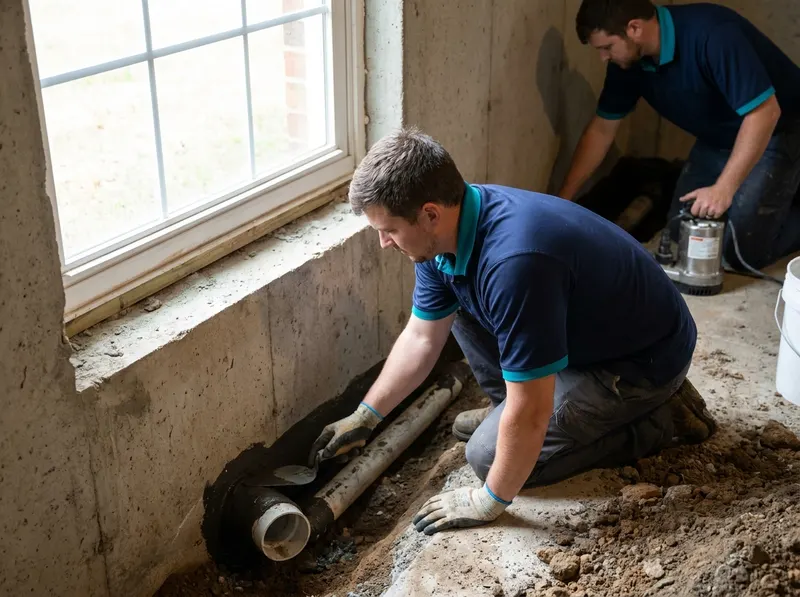
Interior waterproofing is the right fit when water is entering through the floor-wall joint or through weeping cracks in the lower third of the wall, and the exterior grade cannot be economically excavated. A perimeter drainage channel, typically a 4-inch slotted pipe set in gravel at the footing, collects water before it pools on the floor and routes it to a sump basin. A properly sized sump pump then discharges that water away from the foundation. This approach does not stop water from entering the wall material itself, but it controls where the water goes before it damages the interior. For homes in College Hill or Wesleyan Woods where finished basements represent real living space, interior drainage protects flooring and drywall without the disruption of full exterior excavation. The trade-off is that interior systems manage water after it has already reached the footing; they do not reduce the hydrostatic load on the wall the way an exterior membrane does.
Exterior waterproofing, excavating to the footing, applying a waterproof membrane, and installing a drain board and perimeter drain, is the more comprehensive approach and the appropriate choice when walls show active bowing, when cracks are wider than 1/4 inch, or when a home is being prepared for a long-term sale or refinance. Homes near Mercer University and Wesleyan College in Huguenin Heights and surrounding blocks are frequently in the 80, 120-year-old range; exterior work on these properties requires careful hand-digging near old utility lines and brick piers, which adds time but protects adjacent structures. Postline Foundation Repair will tell you plainly if interior drainage is sufficient for your situation, there is no incentive to recommend exterior excavation when a $3,500 interior system solves the problem.
1. Postline Foundation Repair schedules a free on-site visit and inspects the basement walls, floor, and exterior grade. 2. A written findings summary describes the water entry points, probable source, and recommended scope, this document is yours to keep. 3. If waterproofing work is approved, the crew installs the drainage system, sump equipment, or membrane as scoped. 4. After installation, the written warranty terms and sump pump maintenance schedule are reviewed with the homeowner before the crew leaves the site.
Every job gets a firm, written price after a free on-site visit.
Tell us about your basement waterproofing job in Macon and we'll send a clear, written quote, usually the same day.
 Postline Foundation Repair