Macon's soil profile is the root cause of most pier work in Bibb County. The Ocmulgee River basin left expansive red clay throughout neighborhoods like Bloomfield, Napier Heights, and Huguenin Heights, soil that swells…
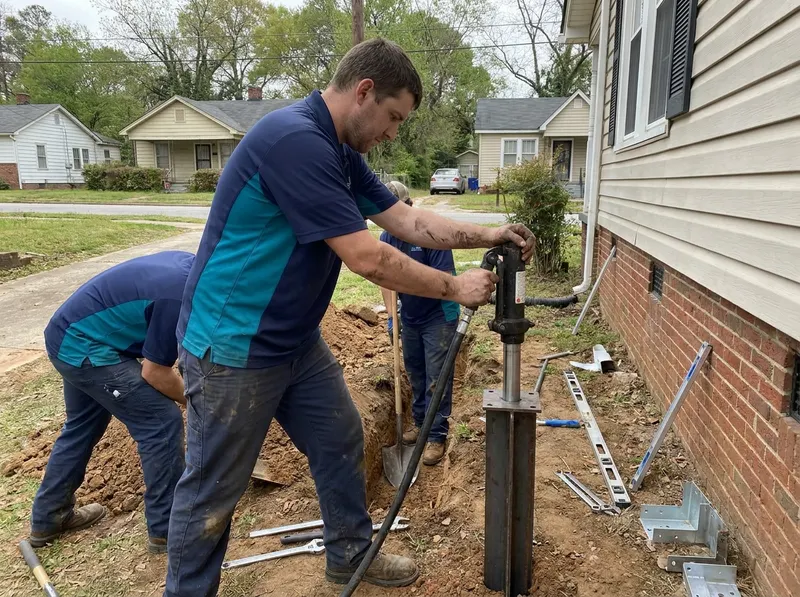
Macon's soil profile is the root cause of most pier work in Bibb County. The Ocmulgee River basin left expansive red clay throughout neighborhoods like Bloomfield, Napier Heights, and Huguenin Heights, soil that swells 3 to 5 percent by volume when wet and contracts sharply during dry summers. That seasonal movement is not uniform across a foundation footprint, which is why homeowners in College Hill and Beall's Hill often see stair-step cracks in brick mortar or doors that stick only in certain corners of the house. Piers work by bypassing that unstable surface clay entirely, reaching the dense Piedmont subsoil or weathered rock layer that does not move with rainfall cycles.
Two pier types cover the majority of Macon residential work. Helical piers, threaded steel shafts screwed into the ground by a hydraulic drive head, suit lighter structures, additions, porches, and sites where excavation space is tight, such as the narrow side yards common in Wesleyan Woods and Unionville. Push piers, hollow steel sections hydraulically pressed in sequence until they reach load-bearing resistance, are the standard choice for heavier exterior walls on full brick homes, including the older two-story Craftsman and Colonial Revival houses throughout Ingleside and Vineville. The selection between the two is determined by load calculations and soil conditions at the specific pier points, not by cost preference. Postline Foundation Repair determines pier type during the on-site assessment, not before it.
A pier installation project follows a defined sequence. 1. Excavation: soil is removed at each pier location, typically to a depth of 2 to 4 feet to expose the footing. 2. Bracket placement: a steel bracket is attached directly to the footing to transfer the structural load to the pier. 3. Pier advancement: sections are driven or pressed in 3-foot or 5-foot increments until the pier reaches refusal, the point where hydraulic pressure confirms contact with stable bearing material, often 15 to 30 feet below grade in Bibb County clay zones. 4. Load transfer: the foundation load is shifted onto the installed piers. 5. Lift attempt: where the settlement pattern and structural condition allow, a controlled lift is performed to recover lost elevation, partial recovery is common; full recovery to original elevation is not always achievable or advisable. 6. Backfill and site restoration.
Not every cracked foundation in Macon requires piers. Hairline shrinkage cracks in poured concrete walls, isolated mortar cracks under 3 millimeters wide, and cosmetic surface spalling rarely indicate active settlement that piers would address. Piers are the appropriate solution when monitoring confirms ongoing vertical movement, when crack patterns show differential settlement across two or more foundation corners, or when a structural engineer's report documents load-path compromise. Postline Foundation Repair's assessment visit is designed to distinguish those situations honestly, including telling a homeowner in Shirley Hills or Wesleyan Woods when monitoring is the right call and piers are not yet warranted. That finding is documented in the written summary left after every visit.
Every job gets a firm, written price after a free on-site visit.
Tell us about your foundation pier installation job in Macon and we'll send a clear, written quote, usually the same day.
 Postline Foundation Repair