Macon's clay-heavy soils in the Ocmulgee basin expand when wet and contract sharply during dry stretches, a cycle that repeats every summer and fall across neighborhoods like Ingleside, Vineville, and Shirley Hills.…
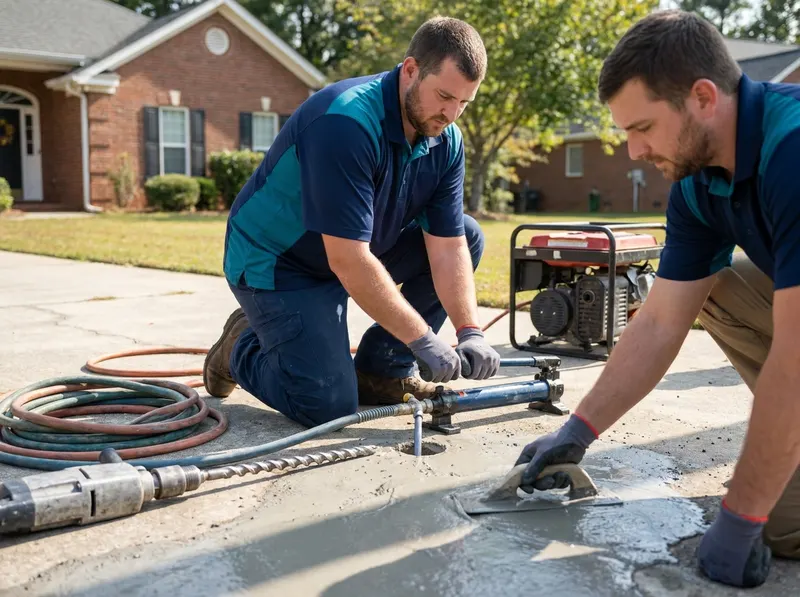
Macon's clay-heavy soils in the Ocmulgee basin expand when wet and contract sharply during dry stretches, a cycle that repeats every summer and fall across neighborhoods like Ingleside, Vineville, and Shirley Hills. That shrink-swell movement pulls soil away from the underside of concrete slabs, leaving voids that allow slabs to sink unevenly under their own weight. The result is a driveway with a 2-inch drop at the garage apron, a front walk that tilts toward the house and holds standing water, or a back patio that has separated from the foundation wall by a visible gap. Concrete leveling addresses the void directly rather than demolishing and pouring new concrete, which typically costs 50, 70% more and requires a 28-day cure before full use.
Two methods are in common use. Mudjacking pumps a cement-soil slurry through 2-inch holes drilled roughly 4 feet apart; the slurry fills the void and the hydraulic pressure lifts the slab. Polyurethane foam injection uses smaller 5/8-inch holes spaced 3, 4 feet apart; the two-part expanding foam reaches full lift strength in about 15 minutes and adds negligible weight to the subbase. Mudjacking is heavier and cures over 24, 48 hours before vehicle traffic. Polyurethane foam costs more per square foot but is the better fit when the slab is near a foundation wall, such as a garage apron in Wesleyan Woods or a stoop in Beall's Hill, where adding 100-plus pounds of slurry could load an already-stressed footing. The technician can identify which method fits the specific slab, void depth, and soil condition during the on-site visit.
Concrete leveling is the right call when the slab itself is structurally sound, no through-cracks wider than 1/4 inch, no crumbling aggregate, no frost heave fractures. A slab that has broken into three or more pieces, or one where the concrete has carbonated and gone soft, is a replacement candidate, not a leveling candidate. In older Macon neighborhoods like Napier Heights, College Hill, and Huguenin Heights, slabs poured in the 1950s and 1960s are often still dense enough to lift cleanly; the technician checks surface hardness and crack pattern before recommending either route. When leveling is not the right answer, the written findings summary explains why and describes what replacement would involve, no upsell pressure, just the observed facts.
Scheduling and site logistics are straightforward. Most jobs require only a standard garden-hose water supply on site (for mudjacking slurry mixing) and a clear 6-foot work path around the slab perimeter. Injection holes are patched with cementitious grout matched to the existing concrete color as closely as the existing slab allows. Patched holes are typically 1, 2 inches in diameter and visible upon close inspection, which is normal and expected, not a defect. Permits are not required for concrete leveling in Bibb County under current residential maintenance codes, but Postline Foundation Repair confirms local requirements before any job begins.
Every job gets a firm, written price after a free on-site visit.
Tell us about your concrete leveling job in Macon and we'll send a clear, written quote, usually the same day.
 Postline Foundation Repair