Middle Georgia's climate creates a specific crawl space problem. Macon averages roughly 45 inches of rainfall per year, and the Ocmulgee River basin's clay-dominant soils hold that moisture near the surface rather than…
Middle Georgia's climate creates a specific crawl space problem. Macon averages roughly 45 inches of rainfall per year, and the Ocmulgee River basin's clay-dominant soils hold that moisture near the surface rather than draining it away. Under a home in Shirley Hills or Wesleyan Woods, ground-level relative humidity can reach 80, 90% during June and July even when the yard looks dry. That vapor moves upward, a process called the stack effect, and saturates floor joists, subfloor panels, and the bottom plates of interior walls. Over two or three seasons, that sustained moisture load creates conditions where wood decay fungi become active and where the dimensional lumber supporting the floor begins to lose structural stiffness. Encapsulation interrupts that cycle at the source by creating a continuous sealed membrane between the ground and the wood structure above it.
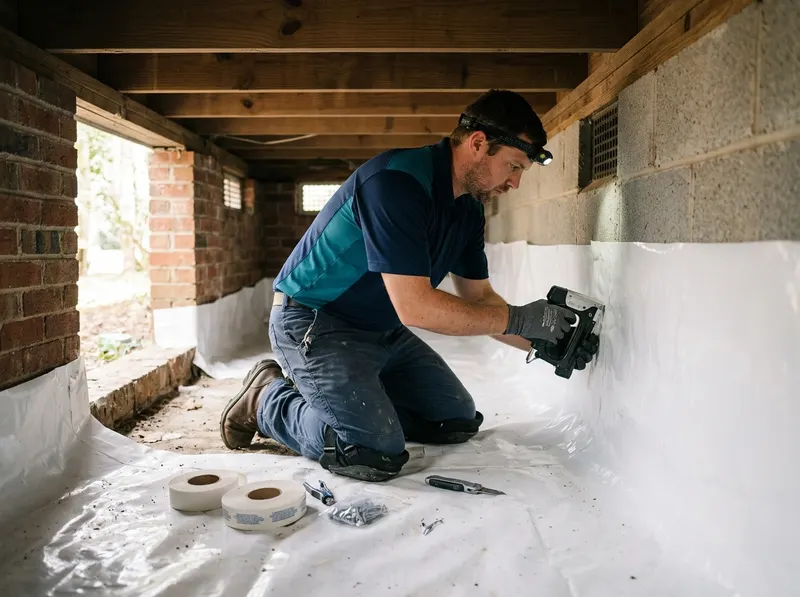
The installation sequence matters as much as the materials. Before any liner is placed, the crawl space floor is graded and cleared of debris, existing vapor barrier scraps are removed, and any standing water or active drainage issues are resolved, skipping that step and simply laying a new barrier over wet ground traps moisture rather than blocking it. A drainage mat (typically 6, 8 mm dimple board) goes down first to allow any residual ground seepage to move to a low point rather than pond under the liner. The 12- to 20-mil reinforced barrier then covers the ground and runs up the foundation walls, where it is mechanically fastened and sealed with butyl tape. Pier columns are wrapped individually so the barrier is truly continuous. A crawl space dehumidifier, sized at roughly 70 to 90 pints per day for a 1,000 to 1,500 sq ft crawl space, then maintains relative humidity below 55% year-round. Homes in Napier Heights, Bloomfield, and Unionville with older block-wall foundations sometimes require additional wall liner where the block face is irregular, which adds labor time but is straightforward work.
Encapsulation is the right fit when the primary problem is moisture vapor and elevated humidity rather than bulk water intrusion from a failed perimeter drain or a high water table. A home in College Hill or Huguenin Heights where water visibly pools after a heavy rain typically needs interior drainage installed before or alongside encapsulation, placing a vapor barrier over an active drainage problem without addressing the source will cause the liner to float or trap water beneath it. An on-site inspection distinguishes the two situations clearly: a moisture meter reading on the floor joists, a hygrometer reading inside the crawl space, and a visual check of the perimeter wall base take about 45 minutes and answer the question definitively. If drainage work is needed first, that scope is quoted separately and honestly, with no pressure to bundle services that are not yet warranted.
For Macon homeowners in Beall's Hill or Wesleyan Woods who have noticed hardwood floors cupping, doors that stick in summer and free up in winter, or a musty smell that migrates into the first floor, those are reliable early indicators that crawl space humidity is already affecting the living area. Encapsulation addressed at that stage, before joist rot sets in, typically costs significantly less than the combined price of encapsulation plus joist sistering or subfloor replacement. The wood moisture content threshold where decay fungi become active is around 19%; a joist reading 14, 16% on a meter is absorbing moisture but has not yet crossed into decay territory, and that window is the most cost-effective time to act.
Every job gets a firm, written price after a free on-site visit.
Tell us about your crawl space encapsulation job in Macon and we'll send a clear, written quote, usually the same day.
 Postline Foundation Repair